Algorithms
How Krawl decides things. Each section: purpose, inputs, steps, a worked example, config knobs, and known limits.
IP evaluation
Purpose. Assign every IP one category — attacker, bad_crawler,
good_crawler or regular_user — from its behaviour. The category drives bans,
banlist exports and the dashboard.
When. analyze-ips runs every minute and takes up to tasks.analyze_ips_batch
IPs (default 2000): those never analysed, then those flagged need_reevaluation,
oldest analysis first. flag-stale-ips (daily) flags IPs seen within
retention.non-suspicious whose last analysis is older than
retention.re-evaluate-interval. Manually categorised IPs are never re-flagged.
Inputs. The IP's access logs from the last 30 days, at most 10,000 rows.
Signals. Each signal is a yes/no flag per category:
| Signal | Measure | Fires when (config) |
|---|---|---|
| Risky methods | share of POST/PUT/DELETE/OPTIONS/PATCH requests | ≥ analyzer.http_risky_methods_threshold (0.1) |
| robots.txt violations | share of requests under a Disallow: path of Krawl's robots.txt |
≥ analyzer.violated_robots_threshold (0.1) |
| Uneven timing | coefficient of variation (std/mean) of gaps between requests in the last analyzer.uneven_request_timing_time_window_seconds (300s) |
≥ analyzer.uneven_request_timing_threshold (0.5) |
| Many user agents | distinct user agents | ≥ analyzer.user_agents_used_threshold (2) |
| Attack URLs | distinct attack types stored for the IP's requests in the window (any field: path, query, body, headers), as detected when each request arrived | ≥ analyzer.attack_urls_threshold (1) |
Scoring. Each category's score is the sum of the weights of the signals that
fired for that category. Default weights (overridable with analyzer.scoring_weights
in config.yaml):
| Signal | attacker | good_crawler | bad_crawler | regular_user |
|---|---|---|---|---|
| Risky methods | 6 (fires if high) | 1 (fires if low) | 2 (fires if high) | 0 |
| robots.txt violations | 4 | 0 | 6 | 0 |
| Uneven timing | 3 | 0 | 0 | 8 |
| Many user agents | 2 | 0 | 6 | 3 |
| Attack URLs | 15 | 0 | 4 | 0 |
The highest score wins. On a tie, the first category in the order attacker, good_crawler, bad_crawler, regular_user wins.
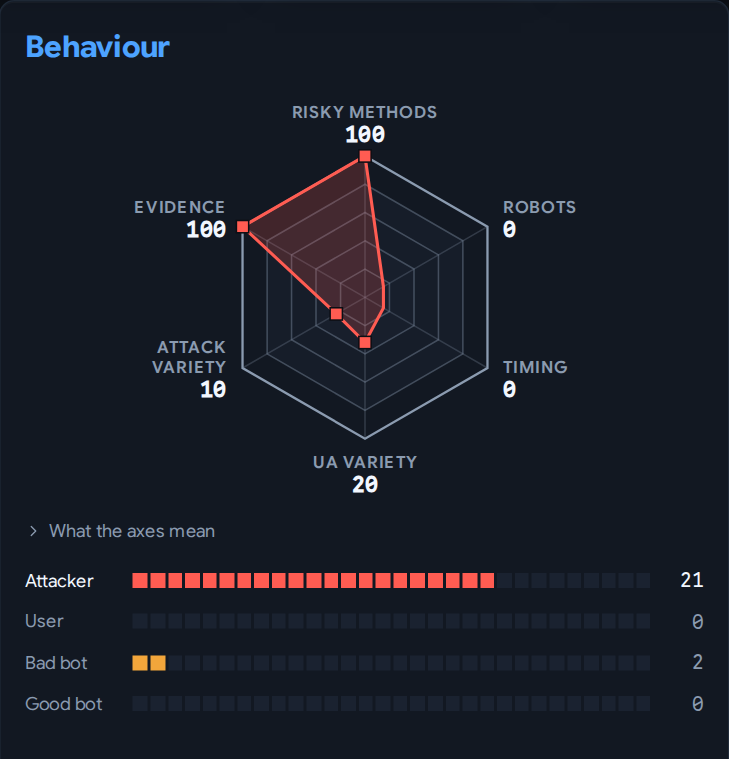
Worked example. An IP sends 40 GETs, 4 POSTs (9% risky), 6 requests under
/admin (a Disallow path, 14%), with 2 user agents and one /.env probe:
- attacker = 4 (robots) + 2 (UAs) + 15 (attack URL) = 21
- good_crawler = 1 (risky share is low)
- bad_crawler = 6 (robots) + 6 (UAs) = 12
- regular_user = 0
The IP becomes an attacker.
Known limits (current behaviour, kept as is):
- The risky-method ratio is computed only when the row count exceeds
http_risky_methods_threshold(0.1), so in practice always. - The
regular_user"many user agents" flag is never set, so its weight (3) is unused. - The stored
uneven_request_timingmetric is the mean gap. The CV that the threshold compares is stored asrequest_timing_cv. - Pruned requests still count in the ratio denominators, so pruning doesn't move a category (see below).
Pruning uninteresting requests
Purpose. Most stored requests are crawlers following Krawl's own random
homepage links: on the demo instance about 3M IPs, each with a handful of unique
paths like /Gw2JM958. Nobody needs those after a week, so they are marked when
written and deleted early, with no per-IP reads of the access log.
Marking. A request is uninteresting only if all of these hold, otherwise
access_logs.is_interesting stays true:
- the method is
GET - it is not suspicious and not a honeypot trigger
- it has no attack types, uploaded files or request assets
- the whole path is one segment of
links.char_spacecharacters, withinlinks.min_length..max_length, with a digit or an uppercase letter after the first character - it is not under a robots.txt
Disallowprefix
The rule also matches readable names with a digit or inner capital, like /HNAP1,
/GponForm, /MyAdmin and /test1. These weren't flagged as suspicious, so losing
them after the window is accepted. All-lowercase paths like /kpjud and paths with
more than one segment are kept. Rows stored before marking existed stay interesting
and age out under retention.non-suspicious.
When. prune-uninteresting runs every 4 hours and deletes uninteresting rows
older than retention.uninteresting (7d), in batches of
tasks.retention_delete_batch, through a partial index.
Counters. Each batch updates ip_stats in the same transaction as the delete:
pruned_requestsandpruned_previouscount two consecutive periods, each as long as a pruned request stays inside the 30-day analysis window (23 days by default). IP evaluation adds an estimate from the two to its denominators: the current period plus the part of the previous one still in the window, assuming a steady rate. GETs from more than two periods ago count for nothing, so they can't hide a new attack. A burst from an IP that then went idle can count for up to one extra period.pruned_totalnever restarts. IP evaluation ignores it.
IP evaluation. Pruned rows are GETs outside robots paths, so they can only add
to the risky-method and robots denominators, which pruned_requests restores. Timing
reads only the last 300s by default; if
uneven_request_timing_time_window_seconds is set above the prune window, timing sees
fewer rows. While an IP has pruned requests, its previous user-agent list is merged
with the current one, so pruning can't lower the distinct count; those user agents can
stay counted past 30 days. Rows with detections are never pruned.
Effects elsewhere.
- Top User-Agents and unique-path counts drop, because pruned rows stop counting.
- Top Paths loses mostly random trap links.
- All-time totals are unaffected: they come from ip_stats.total_requests.